
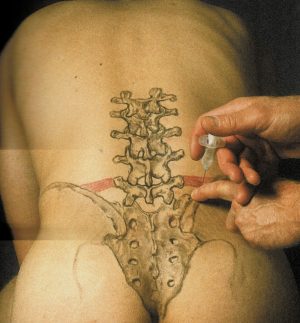
What is Neural Therapy?
Neural therapy is an injection treatment that stimulates healing. The intention is to normalize abnormal stagnant up- or downregulation of the autonomic nervous system and to re-establish a dynamic self-regulating ebb and flow of the autonomic nervous system – that part of the nervous system responsible for the “automatic” functions of the body.1
Developed in Europe in the early 1900s, neural therapy has continued to grow in use. The following article is for the most part from Gerald R. Harris, DO, practicing neural therapy for nearly 30 years.2 It is an effective treatment for chronic pain, especially when practiced by a well-trained physician.
When used in conjunction with other techniques and modalities, neural therapy is very good in helping even the worst cases of chronic problems as it acts primarily through the autonomic nervous system.
WHAT IS THE AUTONOMIC NERVOUS SYSTEM
To understand neural therapy, it is important to understand what the autonomic nervous system (ANS) is. The nervous system has two basic divisions: they are called the somatic (voluntary) nervous system and the autonomic (involuntary) nervous system. The somatic or voluntary nervous system is the part most people are familiar with because it controls voluntary movements such as walking, talking and planned movements. The autonomic (ANS) or involuntary nervous system, on the other hand, regulates internal body functions such as immune function, blood pressure and circulation, hormones, digestion, body temperature, heart rate, breathing, urination, sexual function, menstruation, and other automatic body functions. In other words, the ANS controls vital functions that maintain life without us consciously planning about it. If the ANS is not working well, these internal functions will not perform at optimum levels and ultimately lead to disease and chronic pain.
HISTORY OF NEURAL THERAPY
Neural therapy is a gentle, healing technique developed in Germany that involves the injection of local anesthetics into autonomic nerve ganglia (grouping of nerves), peripheral nerves, scars, glands, acupuncture points, trigger points, and other tissues. Two German physicians practicing in the early 1900s, Ferdinand and Walter Huneke, are considered the founders of neural therapy.2
Neural therapy is based on the theory that any trauma, infection, or surgery can perturb the autonomic nervous system and produce long-standing disturbances in the electrochemical or electromagnetic functions of tissues. When the autonomic nervous system is injured or not functioning correctly, various consequences result.3
DEVELOPMENT OF NEURAL THERAPY
Neural therapy evolved and developed along with the discovery of local anesthetics. The first local anesthetic, cocaine, was first isolated from coca leaves in 1855. It was discovered to have anesthetic effects by the famous Sigmund Freud in 1883. At that time, it was not considered addictive. But because of the addictive and toxic qualities of cocaine, a search for a safer local anesthetic ensued and by 1901, Dr. Alfred Einhorn was commissioned by the Lucius & Brüning company in Frankfürt_Hochst to synthesize procaine (introduced under the trade name “Novocain”).4
In 1906, Spiess and Schleich discovered that infiltration of procaine into a wound greatly enhanced healing. This extreme healing lasted much longer than the duration of action of the actual anesthesia. The famous French surgeon, Leriche, was the first to successfully treat a migraine headache with a local anesthetic nerve block injection and who called Novocain (procaine) “the surgeon’s bloodless knife.” In 1925, the brothers Dr. Ferdinand and Walter Huneke—both sons and grandsons of physicians—discovered the healing aspects of procaine without any prior knowledge of the work of Spiess, Schleich, or Leriche. This occurred by accident when, in 1925, Ferdinand Huneke gave his nurse, whom he had been treating for rheumatism, an I.V. infusion of procaine and her previously therapy-resistant migraine disappeared. This “lightning reaction” impressed Dr. Huneke who realized he may have found a new therapy for pain. He named this new therapy “Healing Anesthetics.” Ferdinand Huneke, along with his brother, Walter, first reported the results of their research into the healing properties of local anesthetics with the publication in 1928 of “Unknown Distant Effects of the Local Anesthesia.” The Hunekes reported that reaction to the injections could help organs at a distant site and described this phenomenon as a reflex. 5 In 1938, Dr. V. Roques from Berlin coined the concept, Neural Therapy.6 The publication of the book “Cybernetics” by Weiner in 1948 led to more clarification about neural therapy in that the main concept of that book is that the body functions as a whole and that every disease, every scar, and every treatment affects the whole body system.
HOW NEURAL THERAPY WORKS
There are several theories on how and why neural therapy works. It can be understood better by a short review of nerve cell physiology. Normal resting nerve cells have a “resting membrane potential” which is the difference between the electrical charges inside the cell and outside the cell.
While at rest, a healthy nerve cell does not generate nerve impulses. Traditionally, the electrical potential difference across a cell membrane is expressed by its value inside the cell relative to the extracellular environment. Resting membrane potentials typically fall within the range of -70 to -80 mV.7 If there is a stimulus to the cell, the membrane resting potential drops. When it drops to approximately 45 mV there is an “action potential” generated12 and the nerve fires an impulse.
In a nerve cell damaged by surgery or trauma, the resting membrane potential is chronically low—for example, it may be at -47 or -50mV.8 This means the nerve will fire off a nerve impulse with much less of a stimulus. Kidd sums this up: “A pathological reduction (usually) or increase (less often) in membrane resting potential leads to a reduced threshold of excitation within the affected tissue. The lower threshold creates chronic low-grade excitation, impaired intracellular metabolism and ion exchange, and persistent inability to maintain a normal resting potential, resulting in chronic neurophysiologic irritability or instability.”9 It is believed that by the repeated infiltration of the local anesthetic around the cell wall, the ion pumps progressively resume normal activity, overcoming the persistent inability to maintain a normal resting potential and eventually the autonomic nervous system starts functioning properly again. This is supported by Procaines’s action on sodium channels, which is the basis of our understanding of its effect on interference fields.10 Procaine temporarily hyperpolarizes both healthy and diseased cell membranes. After the effect of the procaine wears off, the membrane potential of the diseased cell returns to a level closer to normal.11
Posted on June 2020 by Dr. Mary Ann Niez
References:
1 Klinghardt, D. (2018) Healing with injections. Klinghardt Academy-DHS. Washington, USA.
2 https://www.practicalpainmanagement.com/treatments/complementary/prolotherapy/neural-therapy-its-role-effective-treatment-chronic-pain Volume 9, Issue #6.
3 Günther, U. (2017) Neural Therapy Compulsory Course 01. Lecture of Deutsche Gessellchaft für Akupunktur und Neural Therapie training. Berlin,Germany.
4 Popat, S. (2018) Basic Neural Therapy Course. Lecture at Heidelberg University Neural Therapy Meeting. Heidelberg University.
5 Ibid. Ref.2
6 Ibid. Ref.4
7 Chrysafides, Steven et al. Physiology, Resting Potential. StatPearls Publishing LLC. 2020; Available at https://www.ncbi.nlm.nih.gov/books/NBK538338/ Accessed June 4, 2020.
8 Klinghardt D. (2018) Neural Therapy. Lecture at Immersion Week. Bastyr University.
9 Kidd R. Neural Therapy: Applied Neurophysiology and Other Topics. Custom Printers of Renfrew, Ltd. Canada. 2005. p 24.
10 Kidd, R. Neural Therapy in Practice. 2016; 11(7):1. Available at: http://www.neuraltherapybook.com/newsletters/11-7.php. Accessed June 4, 2020.
11 Ibid. Ref.9