
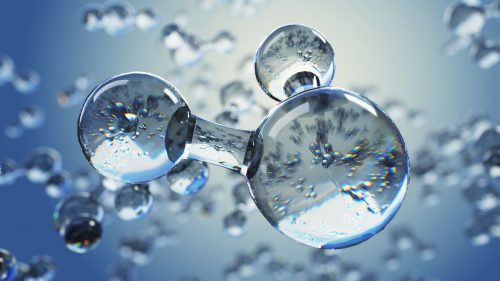
Ozone Therapy is a form of oxygen healing therapy. It is a medical therapy that has been used worldwide for over 50 years with dramatic success and safety. Oxygen in the air we breathe is actually two molecules of oxygen attached together, or O2. Ozone is an ‘activated’ form of oxygen where there are actually three atoms of oxygen attached together, forming a molecule that is “O3”.
Ozone behaves completely differently than oxygen. Ozone is far more energetic and oxidative than Oxygen, which is what makes it so valuable to humanity for so many applications, such as Air Purification, Water Purification, disinfection, and Medical Ozone Therapy Applications.1
Although not being a radical molecule, Ozone is a very strong oxidant. Scientific evidence proved that the effects of Ozone exposure are dose-dependent: low O3 concentrations induce a moderate oxidative eustress activating antioxidant pathways. These properties make Ozone a powerful medical tool, which can be used as either a disinfectant or an adjuvant agent in the therapy of numerous diseases.2
Medical Ozone Therapy Treatments have a wide range of application such as Rectal Insufflation, Ozone Sauna, Vaginal Insufflation, Ear insufflation, Major Autohemotherapy, Minor Autohemotherapy, and more. And their success is mainly anchored on increased oxygen delivery, immune system modulation, and anti-microorganism action.
Oxygen delivery and consumption is the most important factor in health and healing. Red blood cells (RBCs) carry your oxygen from your lungs to your tiny blood vessels called capillaries, which are even smaller than the diameter of your RBCs. From an article of Dr. Robert Rowen3, these are among the benefits of ozone therapy:
1.) Ozone therapy improves red cell flexibility, meaning your blood will flow much better. They will carry a higher negative electrical charge so that they repel each other and don’t stack together. This improves rheological (flow) properties of your blood, enabling more oxygen transport and your RBCs will be able to flex better to get through the small capillaries.
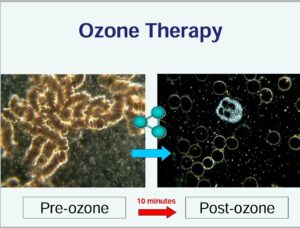
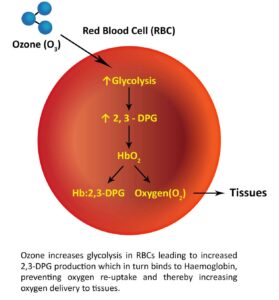
2.) Ozone therapy stimulates your RBCs to generate a compound called 2,3 DGP. Interestingly, this molecule enables your RBCs to release their payload of oxygen into your tissues. In other words, more oxygen delivery to your tissues. Less 2,3 DGP and your RBCs might actually hold on to the payload leaving your tissues oxygen-starved. Chronically ill organs and tissues are oxygen-depleted with their surrounding tissues high in lactic acid. 5
3.) Oxygen utilization is achieved by the mitochondria. Mitochondria are your cell furnaces where energy is made. They are your teeny, tiny but powerful motors. Ozone therapy may turn on overall mitochondrial function in your cells based on basic science studies of German and Cuban researchers showing more oxygen consumption in tissues with ozone administration. More energy, more ability to repair, no matter the tissue or organ.
4.) Researchers Bocci in Italy and Silvia Menendez, PhD, and her team in Cuba have determined that ozone modulates the immune system. In other words, where there is inflammation that is not needed, ozone will dampen it, and allow inflamed tissues to heal. Where the immune system is weak, ozone therapy picks it up. The net effect of ozone therapy is to bring your immune system to a healthier set point of balance. You need inflammation to fight invaders and repair, but when inflammation is not turned off, the inflammation itself then becomes destructive to your tissues. In the case of joints, modulating inflammation with ozone can sometimes lead to instant results.
5.) Ozone and its metabolic products are directly toxic to pathogens. In fact, ozone virtually instantly punches holes in the membranes of bacteria, hemorrhaging them on the spot. In contrast, chlorine compounds, well known as disinfectants, are 100x slower!
6.) When it comes to viruses, these stealth pathogens must gain entry into your cells to wreak havoc, no matter the virus. Research has shown that most viruses require fully-functional and reduced sulfhydryl groups (SH) on their outer shell to attach to and enter your cells. According to prevailing literature, the SH groups are the “fingers” viruses use to open and enter your cells.
7.) Ozone is extremely reactive oxygen. It will strip the H off the SH as follows:
SH + SH +O3 > S-S = H2O + O2.
This is called “oxidation”. If the SH groups are oxidized to S-S, the virus is inactivated. Alterations of these sulfhydryl residues will change the virus’ biochemical activity, altering their three-dimensional structure and have been found to “Cripple” virus growth properties.8 This should enable you to mount a proper and fast immune defense and dispatch the invader without significant damage to you!
The only residual product is oxygen and water, which your body utilizes, so no toxicity whatsoever!
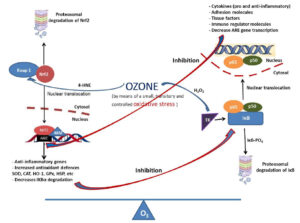
In experimental models and existent clinical studies, homeostasis of the free radical and antioxidant balance by Ozone Therapy was associated with a modulation of NF-κ B/Nrf2 balance and IL-6 and IL-1β expression. These molecular mechanisms support the cytoprotective effects of ozone therapy against tissue damage present in many inflammatory diseases, including viral infections. 9
8.) Ozone Increases the Activity of your “Anti-Oxidant Enzyme Systems.10
9.) Ozone Kills Cancer cells on contact.
10.) Ozone can be anti-aging!11
WHERE DOES OZONE COME FROM?
Ozone is created in nature and can also be created by machines called ozone generators.
Natural Ozone
In nature, Ozone is created near the edge up space when Ultraviolet Radiation (UV) coming from the sun makes contact with the oxygen in the atmosphere. The energy from the UV is imparted to the oxygen and turns some of the oxygen (O2) into Ozone (O3). The layer of Ozone that is created is referred to as “The Ozone Layer”. The Ozone Layer is not only created by UV’s interaction with oxygen, but it also protects the Earth from UV rays coming from the sun. If it was not for the Ozone Layer, life as we know it would not exist on planet Earth.
Ozone is also created here at ground level, in many different places and by different processes. For example Ozone is created when UV light from the sun interacts with water spray and foam in waves. It is also created by water falls. Have you ever wondered why the air smells so fresh by the sea side or by a water fall? It is because there is ozone in the air in these areas.
Isn’t ozone “smog”? So isn’t’ ozone toxic?
On hot days in cities, they always report the smog levels. If the smog levels are high they warn elderly and those of ill health to stay indoors. How do they measure the smog levels? The problem with smog is that ‘smog’ is actually a complex ever-changing mixture of toxic gasses and particles. Since the constituents of smog are changing all the time, it is very difficult to measure it accurately. Early on it was noted that when smog levels are high, it is accompanied by a high level of ozone in the air. When smog levels are low, there is a low level of ozone in the air. We can all thank Mother Nature for the Ozone, as it is there to destroy (oxidize) the toxic chemicals in smog and return the air to a breathable status. But since ozone is so easy to measure, scientists gave up trying to measure smog and instead rely on ozone levels to indicate how much smog is in the air. Since they are measuring ozone levels, the word “Ozone” became synonymous with ‘smog’ and everyone gets the idea that ozone is toxic (which of course, it is not).
Ozone is also created by thunderstorms. The lightning you see in the sky is a discharge of energy that had been building in the thundercloud. When the lightning bolt contacts the air, some of the oxygen (O2) in the air is turned into Ozone (O3). That fresh clean smell you experience during and after a thunderstorm is actually the smell of ozone.
Ozone Made by Machines
In the late 1800’s it was found that ozone could be made artificially by exposing air to. The more energy you exposed the air to, the more ozone you can create. The machine used to create the ozone was simply referred to as an ‘ozone generator’. There are thousands of different ozone generators on the market, and hundreds of different ways to design and build them. They typically use two different types of technologies to generate the ozone: UV (Ultraviolet Radiation) and an electrical discharge method commonly referred to as Corona Discharge. While UV is simple to understand and use, the applications are limited due to the relatively low ozone output capabilities of a UV ozone generator. Since Medical Ozone Therapy requires relatively high ozone concentrations, the UV Technology is therefore usually reserved for very light water purification or air purification. Higher concentrations of ozone are available from the Corona Discharge technologies, but because there are hundreds of very different Corona Discharge technologies, they are more difficult to understand. The difficulty in understanding how they work makes it more difficult for the average consumer to know if they are purchasing the proper ozone generator or not.
Because of the complexities of ozone generators, it would be best if you read as much as you can before making a purchase. If you wish to know more about how an ozone generator works, and which ones are suitable for your application, you should first investigate all of the Corona Discharge technologies, make sure you know if the proper technology is in the ozone generator that you are considering purchasing. You must also ensure that the ozone, when inside the machine, does not come into contact with any components that are plastic, rubber, or metal, otherwise the ozone that is produced could be toxic. You also need to ensure that the ozone generator produces the proper ozone concentrations, or strengths of ozone, otherwise it simply will not work for you.12
THE HISTORICAL DEVELOPMENT OF OZONE
The year 1840 is given as the year in which ozone was discovered by a professor of physics and chemistry, Christian Friedrich Schönbein – a contemporary of famous scientists such as Volta, Jenner, Dalton, Ampere, Fraunhofer, Ohm, and Faraday, to name a few.
In 1857, with the invention of the “superior induction tube” by Werner von Siemens, the first technical ozone unit was constructed. Thereafter, Dr. Kleinmann carried out his earliest bacteriological trials on pathogenic germs and the first ozone insufflations, subsequently testing the influence of ozone on animal and human mucous membranes.
Exactly 100 years after, Joachim Hänsler developed the first medical ozone generator to make accurate dosing of ozone/oxygen mixtures possible, thus, opening up a wide spectrum of therapeutic applications.13
Is Ozone therapy safe?
Given the right training and understanding of its use and application, the answer is, Absolutely yes! The ozone molecule alone is a strong oxidant, but it is clinically administered in low doses and controlled treatments. 8
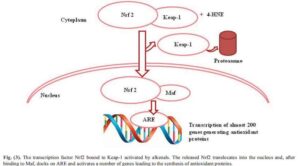
Recent evidence has shown that treatment with a low concentration of ozone in cultured cells promotes nuclear translocation of Nrf2 at the chromatin sites of active transcription and increases the expression of antioxidant response element (ARE)-driven genes. This is responsible for increased mitochondrial function with reduction of oxidative stress and inflammation. Importantly, evidence has shown that ozone-induced ARE activation can be reverted by the ectopic expression of the Nrf2 specific inhibitor Kelch-like ECH associated protein (Keap1), thus proving the role of the Nrf2 pathway in the antioxidant response induced by mild ozonisation.14
Is Ozone safe when combined with conventional therapies?
The Ozone molecule, on its own, has a very limited life. But its effect on immune regulation could be so profound and has, in fact, significantly helped long term outcomes both for the acutely and chronically ill patients.
Even though advances in our understanding of immune function and regulation have allowed a greater intellectual understanding of the potential mechanism of aberrant immune function in diseases, the extraordinary complexity of the immune system, with its various inductive regulatory and feedback mechanisms, has made it clear to clinical investigators that perturbation of the system by pharmaceutical agents used for therapeutic purposes may have multifaceted effects on the system – some of which might be unpredictable, resulting in temporary dampening of the expression of the disease process, yet the adverse effects far outweighs the resultant short-sighted efficacy. Nonetheless, despite these general caveats, certain immunoregulatory agents have been successful with biological agents and 02/03 therapy given in low dose and appropriately employed, resulting in impressive results.15